First NSF NOIRLab Follow-Up Observations Triggered by NSF–DOE Rubin Alerts
Republished from NOIRLab, the U.S. National Science Foundation's National Optical-Infrared Astronomy Research Laboratory, where it first appeared as a press release on 2026-03-10. NOIRLab press-release texts and images are released under the Creative Commons Attribution 4.0 International licence; the text is reproduced here unchanged apart from formatting. Credit: NOIRLab. Read the original for the latest version and any updates.
NSF NOIRLab, funded by the U.S. National Science Foundation, has completed end-to-end runs of its ecosystem for following up on alerts from NSF–DOE Vera C. Rubin Observatory. The runs demonstrated how multiple NOIRLab-developed software tools, plus a network of telescopes around the globe, will enable quick follow-up observations of the countless transient objects that Rubin will uncover during its ten-year survey.
NSF NOIRLab has successfully demonstrated end-to-end use of its real-time follow-up ecosystem designed to quickly respond to alerts generated by NSF–DOE Vera C. Rubin Observatory, which is jointly funded by the U.S. National Science Foundation (NSF) and the U.S. Department of Energy's Office of Science (DOE/SC). Alerts from Rubin point the scientific community to objects in the night sky that change in position or brightness, such as asteroids, interstellar comets, and exploding stars. Due to their fleeting nature, rapid follow-up observations are crucial for studying these objects.
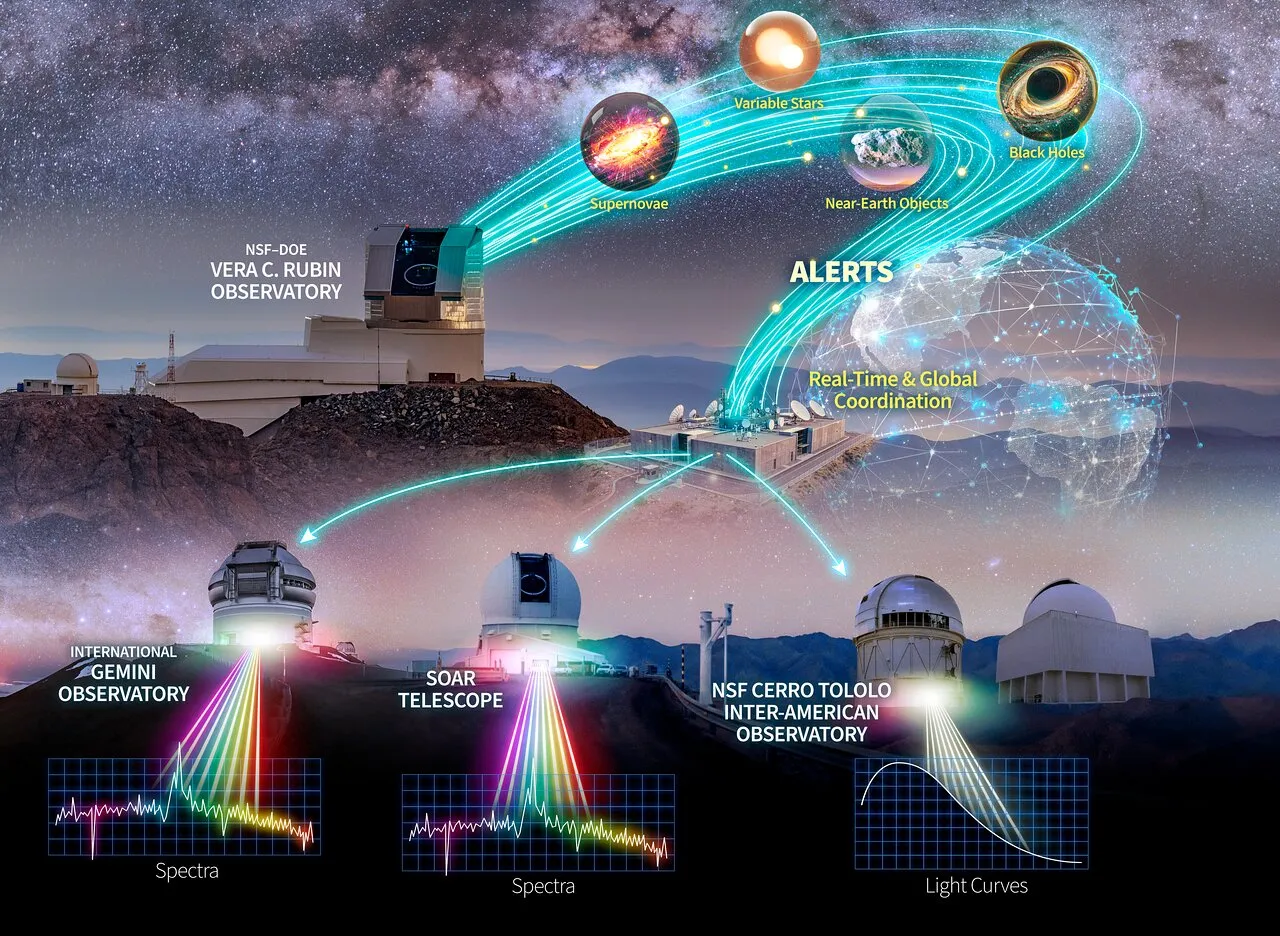
NOIRLab has developed a series of tools to enable scientists to quickly and efficiently follow-up on alerts from Rubin. These tools include an alert-filtering system, an automatic observation request manager, a network of telescopes to carry out observations, and automatic data reduction software. Together these tools make up an integrated ecosystem that helps process the millions of alerts that Rubin is expected to generate every night once it begins its Legacy Survey of Space and Time (LSST).
To interpret the immense flow of data from Rubin, scientists rely on a network of intelligent software platforms known as brokers. These systems use machine learning algorithms to filter, sort, and classify the alerts before distributing them to the scientific community.
NOIRLab operates one of these community brokers: the Arizona–NOIRLab Temporal Analysis and Response to Events System (ANTARES). This sophisticated software tool receives alerts from Rubin and filters them in real time into categories depending on the object’s characteristics. Scientists can subscribe to filters and be notified of new alerts for objects that are of interest to them, whether that be supernovae, variable stars, objects that shine in a specific wavelength of light, or variable objects that are located in a certain region of sky.
Once ANTARES filters the alerts, it sends them to another NOIRLab-built software tool called the Gemini Observation and Analysis of Targets System (GOATS). GOATS was developed by the Science User Support Department (SUSD) of the International Gemini Observatory, funded in part by the NSF and operated by NSF NOIRLab. This browser-based interface allows selection of objects for follow-up and automatically submits the observation requests to a network of telescopes called the Astronomical Observatory Event Network (AEON).
AEON is a collaboration of telescopes located around the world, including: the NSF Víctor M. Blanco 4-meter telescope at NSF Cerro Tololo Inter-American Observatory (CTIO) in Chile, a Program of NSF NOIRLab; the SOAR 4.1-meter telescope located on Cerro Pachón in Chile and operated by CTIO; the Gemini South telescope in Chile and the Gemini North telescope in Hawaiʻi; and the global network of telescopes that make up the Las Cumbres Observatory [1]. Las Cumbres Observatory runs the robotic scheduling software that AEON uses to manage the incoming observation requests for SOAR and Blanco.
After observations are completed, data processing commences either automatically through telescope-specific pipelines, or, in the case of Gemini, directly on GOATS through the built-in DRAGONS software [2]. In either case, NOIRLab’s integrated follow-up ecosystem allows scientists to quickly access the processed results, classify the object, and decide if further observations are needed.
During the end-to-end run, the team followed-up on a total of 18 alerts from Rubin that were flagged by ANTARES as likely being supernovae. The instruments used during observations were the 570-megapixel DOE-fabricated Dark Energy Camera (DECam), mounted on the Blanco telescope, the Goodman spectrograph mounted on SOAR, and the Gemini Multi-Object Spectrographs (GMOS) mounted on both the Gemini North and Gemini South telescopes [3].
To aid in classification, additional images of the targets were acquired with the Las Cumbres Observatory’s 1-meter and 2-meter telescopes. This allowed the team to build light curves, which show how the target changes in brightness over time.
“This is definitely a proud moment for NOIRLab and all the folks who have been involved over the years,” says Monika Soraisam, lead scientist of GOATS. “It’s so gratifying to see how all the pieces came together so neatly to make the whole system work end to end.”
“The time-domain community, including NOIRLab, has been building the infrastructure needed to do efficient follow-up from Rubin alerts for over ten years and it is very rewarding to see the entire ecosystem working as we had envisioned,” says Bryan Miller, lead for science operations development at Gemini Observatory. “Lessons learned from the demonstration will be used to improve the systems that we will provide to the community.”
The follow-up observations conducted during the run led to the classification of one Type II supernova, which results from the explosion of a massive star which still retains a hydrogen rich outer envelope, one candidate Type Ic supernova, which also results from the explosion of massive stars but after they have lost their outer layers, and two Type Ia supernovae, which are due to exploding white dwarf stars and are used to measure the expansion rate of the Universe.
The successful end-to-end run of the follow-up ecosystem demonstrates how the global scientific community will use Rubin data to study the Universe like never before. Throughout LSST, scientists will be alerted to billions of changing objects across the southern hemisphere sky. With rapid, coordinated follow-up, they will be able to study them before they fade away or leave our field of view.
“Rapid and efficient follow-up across an integrated ecosystem of facilities is critical in order to enhance and enrich the science being done with LSST data,” says César Briceño, Director of SOAR.
“The value added by such prompt follow-up allows investigators to fully exploit the treasure trove of discoveries that LSST will uncover,” says Steve Heathcote, Director of CTIO.
“This is such an exciting moment,” adds Chris Davis, NSF Program Director for NOIRLab. “This new system will transform time domain astronomy and will undoubtedly lead to countless new and exciting discoveries.”
Notes
[1] NSF recently funded AEON+, through a grant led by Las Cumbres, in order to expand the AEON facility infrastructure to additional telescopes and across the wavelength spectrum.
[2] Spectra from SOAR are processed using the SOAR Goodman Live Pipeline. Data from DECam and Las Cumbres Observatory are processed using their respective image processing pipelines.
[3] To carry out the observations, Gemini used a development version of its future observing system, the Gemini Program Platform.
Sources
Written for readers, not for research. Check the sources before you cite anything.